



Let us simplify your medical billing.

Speech therapy plays an essential role in helping patients improve communication, language, swallowing, and cognitive skills. However, running a successful speech therapy practice requires more than providing quality patient care. Healthcare providers must also manage medical billing, coding, insurance claims, documentation, and reimbursement processes. These responsibilities can become challenging when billing requirements change or insurance companies request additional information. Tailored speech therapy billing and coding solutions in the USA help speech-language pathologists manage these administrative tasks efficiently. With specialized billing support, therapy practices can reduce claim errors, improve revenue cycle management, and spend more time focusing on patient outcomes.
Speech therapy billing and coding services involve translating patient treatments into accurate medical claims for insurance reimbursement. These services require a clear understanding of speech-language pathology procedures, payer policies, documentation standards, and applicable billing codes. Professional billing specialists review patient records, identify the appropriate Current Procedural Terminology (CPT) codes, verify diagnosis information, and submit claims according to payer requirements. They also ensure that claims contain the information needed for processing and reimbursement. Since speech therapy services may involve different treatment approaches, each claim must accurately reflect the services provided. A structured billing process helps practices avoid preventable mistakes, reduce administrative pressure, and maintain more consistent cash flow.
Every speech therapy practice has different operational needs, patient populations, and insurance arrangements. Therefore, a standard billing process may not address every challenge. Tailored speech therapy billing solutions provide support based on the specific requirements of individual providers, private clinics, rehabilitation centers, and multidisciplinary healthcare facilities. Services may include patient registration, insurance verification, charge entry, claim submission, payment posting, and accounts receivable follow-up. Billing workflows can also be adjusted to accommodate the practice’s scheduling system, electronic health record software, and payer mix. This customized approach helps healthcare providers maintain organized financial operations while improving visibility into outstanding claims, payment delays, and reimbursement trends.
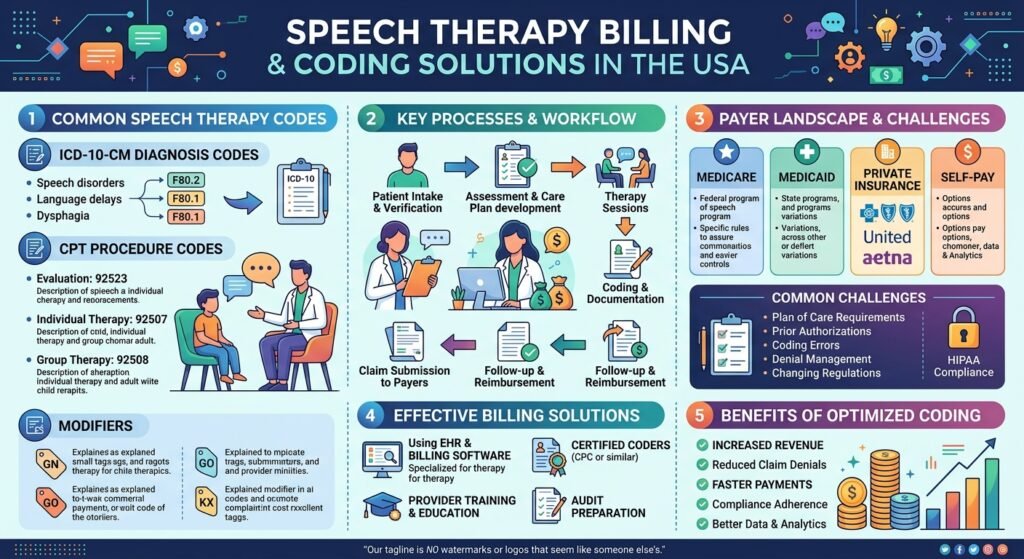
Accurate medical coding is essential for receiving appropriate reimbursement and maintaining compliant billing practices. Speech-language pathologists provide a variety of services, including speech sound treatment, language therapy, voice therapy, cognitive-communication rehabilitation, and swallowing assessment or treatment. Each service must be documented and coded according to the applicable coding guidelines and payer requirements. CPT codes describe the services performed, while ICD-10-CM diagnosis codes communicate the patient’s documented medical condition or reason for treatment. Coding specialists review clinical documentation to help ensure that the selected codes reflect the actual services delivered. They also monitor relevant coding updates and payer-specific instructions. Accurate coding can reduce claim rejections, support medical necessity, and improve the reliability of a practice’s billing process.
Insurance verification is an important step in preventing unexpected billing problems. Before treatment begins, billing teams can confirm a patient’s insurance eligibility, review available speech therapy benefits, and identify relevant coverage limitations. Depending on the insurance plan, patients may have requirements involving referrals, prior authorization, visit limits, deductibles, copayments, or coinsurance. Understanding these requirements helps providers explain potential financial responsibilities before services are delivered. Billing specialists can also contact insurance companies when coverage details are unclear and document the information received. Although eligibility verification does not guarantee claim payment, it helps practices identify potential reimbursement barriers early. As a result, patients receive clearer financial information, and providers can make better-informed administrative decisions.
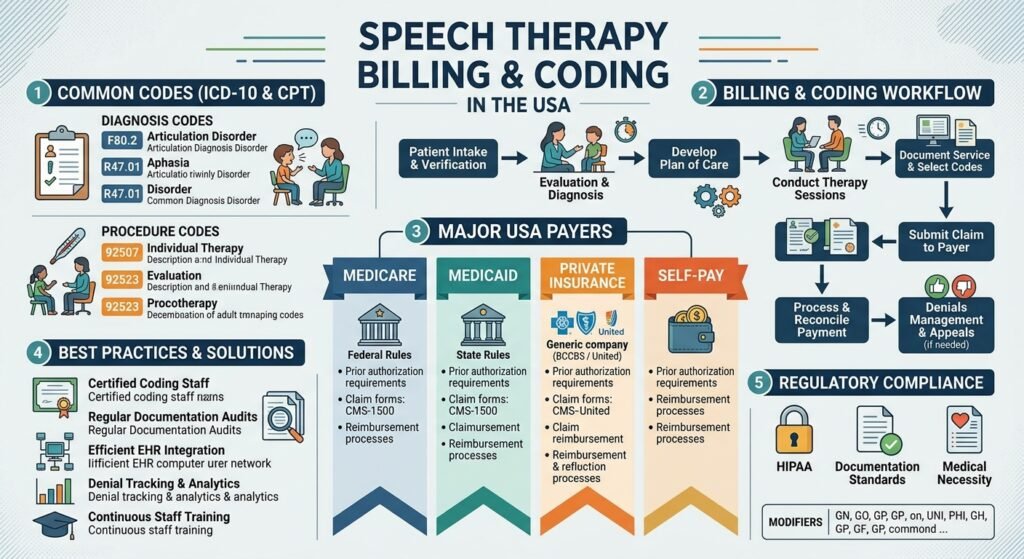
Timely and accurate claim submission is essential for maintaining a healthy revenue cycle. Speech therapy practices must submit claims with complete patient information, correct provider details, appropriate procedure and diagnosis codes, and the required supporting documentation. Missing information, coding inconsistencies, and incorrect insurance details can cause delays or denials. Professional billing teams review claims before submission and use available electronic billing systems to track their progress. They also monitor payer responses and investigate claims that remain unpaid beyond expected processing periods. When additional information is required, billing specialists coordinate with the practice to address the issue. A well-organized claim management process helps reduce unnecessary delays and gives providers a clearer understanding of their expected reimbursements.
Claim denials can create serious financial challenges for speech therapy practices, especially when the same problems occur repeatedly. Common denial reasons include missing prior authorization, insufficient documentation, incorrect coding, eligibility issues, and services that do not meet a payer’s medical necessity requirements. Effective denial management begins with identifying the reason for each denial and determining the appropriate corrective action. Billing specialists may correct claim information, submit missing documentation, contact the payer, or prepare an appeal when supported by the patient’s records and applicable policies. They can also analyze denial patterns to identify recurring problems within the billing workflow. By addressing the underlying causes, practices can reduce avoidable denials, improve claim resolution, and protect revenue that might otherwise remain unpaid.
Accounts receivable management helps speech therapy practices track outstanding payments and maintain financial stability. Unpaid claims can accumulate when follow-ups are delayed, payer responses go unnoticed, or billing responsibilities are not clearly assigned. Professional revenue cycle management services monitor outstanding balances, prioritize aging claims, investigate underpayments, and follow up with insurance companies. They may also review payment posting to ensure that received payments are recorded correctly and discrepancies are identified. Regular financial reporting provides insight into collection trends, denial rates, and unresolved balances. With a structured accounts receivable process, speech therapy providers can identify revenue bottlenecks earlier and make informed decisions about staffing, scheduling, and practice growth. Consistent monitoring also supports better financial planning.
Compliance is a fundamental part of medical billing in the United States. Speech therapy claims must be supported by accurate clinical documentation and submitted according to applicable federal requirements, payer contracts, and coding guidelines. Documentation commonly includes evaluation findings, treatment plans, progress notes, services delivered, and evidence supporting medical necessity when required. Providers must also follow relevant privacy and security requirements, including applicable Health Insurance Portability and Accountability Act (HIPAA) obligations. Billing teams can help identify missing information, maintain organized claim records, and communicate documentation concerns to clinicians. However, billing support does not replace the provider’s responsibility for accurate clinical records and appropriate treatment decisions. A consistent compliance process helps reduce administrative risks and supports more reliable reimbursement practices.
Outsourcing speech therapy billing can help healthcare providers reduce administrative workloads and improve billing consistency. Instead of managing every claim internally, practices can work with specialists who understand medical billing workflows, payer communication, coding requirements, and denial follow-up. This arrangement may reduce the need for additional in-house billing staff and provide access to specialized administrative support. Outsourced teams can also help practices monitor outstanding claims, organize financial reports, and identify recurring reimbursement problems. The overall value depends on the billing company’s experience, service quality, communication process, pricing structure, and familiarity with the practice’s requirements. Providers should evaluate these factors before selecting a partner to ensure that the arrangement supports operational efficiency and financial goals.
Tailored speech therapy billing and coding solutions in the USA help healthcare providers manage complex administrative responsibilities while maintaining an organized revenue cycle. From insurance verification and accurate coding to claim submission, denial management, and accounts receivable follow-up, specialized billing support addresses the financial processes that keep a practice operating effectively. Customized workflows can improve claim accuracy, identify reimbursement issues, and reduce the burden of routine administrative work. However, successful results also depend on complete clinical documentation, appropriate treatment decisions, and compliance with applicable payer requirements. By choosing an experienced billing partner and maintaining effective communication, speech-language pathologists can strengthen their financial operations and focus more of their time on helping patients improve communication and quality of life.


Legacy Billing Solutions provides professional healthcare billing services tailored to behavioral health providers. Our reliable revenue cycle management solutions reduce administrative workload, improve financial performance, and support long-term operational success. We focus on accuracy, compliance, and timely reimbursements to ensure steady cash flow and long-term financial stability for your practice.
©2026 Legacy Billing Solutions. All Rights Reserved.